Key Takeaways
- January brings the sharpest surge in demand: After the holiday slowdown, divorce and custody inquiries rebound hard. Across seven years at the US Legal Groups firms led by our CEO, January paid consultations ran 48% higher than December on average.
- Google Ads needs a ramp-up period: Ad approvals, conversion tracking, and Smart Bidding all need several weeks of live data before an account can spend aggressively and efficiently.
- Build in November, test in December, scale in January: This sequence keeps your account out of its learning phase when click costs peak.
The Common Pitfall
Every fall, family law firm owners tell us the same thing: “Let’s hold off on ads until after the holidays.”
The logic makes sense on the surface. Most people considering divorce wait until the holidays are over before calling a lawyer, so why pay for ads in December?
The problem is how Google Ads works. Launch on January 1 and your account spends the most competitive weeks of the year in its learning phase. Bidding is guesswork, ads may still be in review, and tracking problems get fixed on the fly. By the time the account is running efficiently, the January surge is already behind you.
Mark your calendar: The first working Monday of the new year, often called “Divorce Day,” kicks off the annual surge in family law inquiries. In 2027, that’s Monday, January 4.
What the Data Shows
We don’t have to guess about January. Our CEO, David Crum, is a practicing divorce attorney who leads four family law firms: Colorado Legal Group, Kansas Legal Group, Nebraska Legal Group, and New Mexico Legal Group. Their intake numbers tell the story.
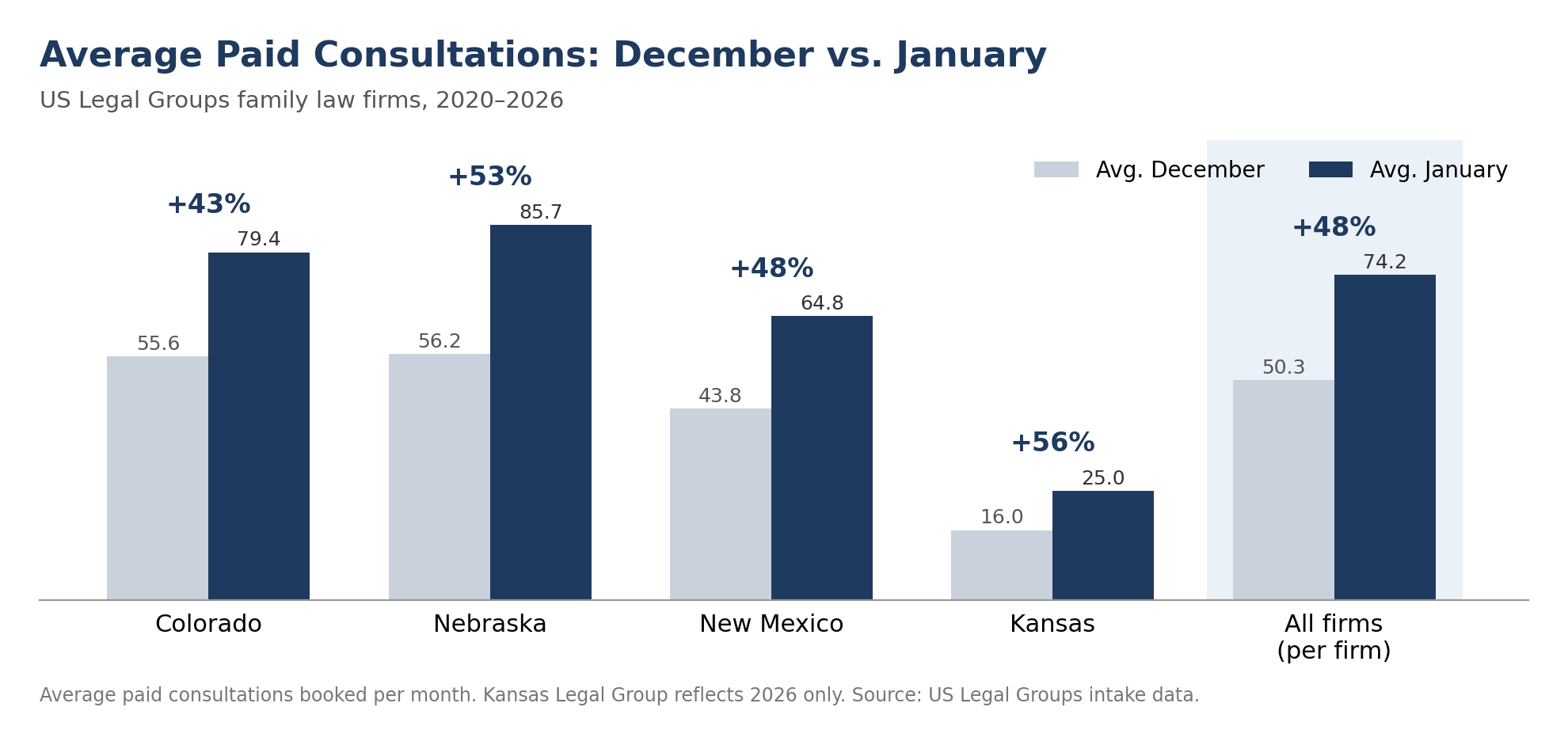
Across seven years of intake data at the US Legal Groups firms, January paid consultations ran 48% higher than December on average. Most recently, they climbed 33% heading into 2026, with every firm up. These aren’t free phone screens or web form fills. Each one is a prospective client who paid to sit down with an attorney.
| Firm | Years | Avg. December | Avg. January | Increase |
|---|---|---|---|---|
| Colorado Legal Group | 2020–2026 | 55.6 | 79.4 | +43% |
| Nebraska Legal Group | 2021–2026 | 56.2 | 85.7 | +53% |
| New Mexico Legal Group | 2021–2026 | 43.8 | 64.8 | +48% |
| Kansas Legal Group | 2026 | 16.0 | 25.0 | +56% |
| All firms (per firm) | 2020–2026 | 50.3 | 74.2 | +48% |
That lines up with what family law attorneys report nationally. As a recent Forbes analysis of “Divorce Month” points out, January may not be the year’s peak for divorce filings, but inquiries climb sharply after the slowdown from Thanksgiving through New Year’s. University of Washington research found that filings themselves spike in March and August, which fits what we see: January consultations turn into retained clients and filings in the weeks that follow. For a firm’s intake team, the January rebound is what matters.
In 2025, January was the busiest month of the year for paid consultations across all four firms, running 32% above the monthly average. And the surge doesn’t stop at consultations. January’s paid consultations keep converting into retained clients through March and April, so a firm that starts slow loses more than one month of business.
Why January Is Different
- Searchers are ready to act. People who held it together through the holidays start January determined to move forward. They search for things like “how to file for divorce” and “custody attorney near me,” and they often hire the first credible firm that picks up the phone.
- Clicks cost more. Competing firms raise budgets at the same time, which pushes up what Google Ads cost for family law firms. A brand-new account launched cold in January bids top dollar with no data, against established accounts that already know which searches turn into retained clients.
- Every high-intent search counts more. As AI-generated answers absorb more of the long-tail searches that used to send firms traffic, the high-intent searches that remain are worth more. Spending January in a learning phase costs more than it used to.
Why the Build Starts in November
A Google Ads campaign for a divorce firm isn’t ready the day you hit publish. Three things need runway.
1. Ad Approvals
Google scrutinizes legal advertising closely. Standard ads often approve quickly, but copy that mentions sensitive topics like domestic violence or child support can get flagged or delayed, and appeals can take longer over the holidays. Every ad, keyword list, and landing page should be approved before December.
2. Conversion and Call Tracking
If calls, form fills, and chats aren’t tracked cleanly, Smart Bidding optimizes for the wrong things. November gives you time to test call tracking numbers, remove duplicate conversion goals, and confirm forms are recording correctly. If your intake software allows it, feed booked consultations and retained clients back into Google Ads so the system learns to find real cases, not just clicks.
3. The Smart Bidding Learning Phase
When a new campaign launches, Google’s bidding algorithm goes through a learning period while it figures out which clicks turn into inquiries. The “Learning” label usually clears within about a week, but performance takes longer to stabilize on lower-volume accounts like family law. If that happens in early January, you’re paying peak prices for trial and error.
November Start vs. January Start
| Account Area | November Start | January Start |
|---|---|---|
| Ad Approvals | Fully approved before December | Still in review during peak weeks |
| Call and Form Tracking | Tested on live inquiries | Fixed while spending heavy budget |
| Negative Keywords | Irrelevant searches already filtered | Found after paying for wasted clicks |
| Smart Bidding | Learning complete, bids calibrated | Bidding blind at peak prices |
| Landing Pages | Conversion rates proven at lower cost | Untested during high volume |
| Intake | Front desk practiced on ad leads | First live test during the rush |
| Budget | Scaling from proven baseline data | Maximum spend from a cold start |
December: The Controlled Test Run
For an account built in November, December is a diagnostic run. The goal is data, not volume.
- Find out what things really cost. December shows which practice areas (contested divorce, custody modifications, and so on) produce inquiries and where cost per lead runs too high, so you can shift budget before January.
- Give Smart Bidding enough to learn from. A modest budget shouldn’t mean starving the account. Smart Bidding needs a meaningful number of conversions before it can bid well, so keep December spend high enough to generate real inquiries. Many accounts start on Maximize Clicks or Maximize Conversions without a target, then add a target CPA once there’s conversion history to support it.
- Run an intake dress rehearsal. December call recordings show whether the front desk answers quickly, how fast web leads get a follow-up, and whether calls roll to voicemail at lunch or after 5:00 PM. Fix those gaps before the rush.
January: Scale From a Baseline
Firms that launch in November reach January with something a cold start can’t buy: a baseline. With a month of real cost-per-lead and search term data, January decisions are based on evidence, not assumptions.
- Raise budgets where they’re limiting leads. Impression share data shows where budget caps are choking lead flow. Increase budgets in 15 to 20% steps so the algorithm scales smoothly without resetting its learning.
- Prepare for Divorce Day. If last year’s data shows conversion rates jumping during Divorce Day week, a seasonality adjustment can tell Smart Bidding to expect it in advance. Google recommends these only for short, major changes, so apply one to that week rather than the whole month.
- Match ad schedules to intake. December call logs show exactly when calls get missed. Run ads when someone is there to answer.
- Watch the competition. Auction insights show when competing firms enter the auction or raise bids, so you can adjust before you lose position.
Already Running Ads? Don’t Pause in December
If your firm already has an active account, it’s tempting to pause over the holidays and restart in January. Pausing throws away momentum and can push the account back into learning right when you need it most. Use December to clean up search terms, tighten negative keywords, and verify tracking instead.
Measure What Actually Matters
Clicks and impressions don’t pay the bills. Judge a family law campaign on business results:
- Qualified inquiries: Leads that match your ideal client profile and jurisdiction.
- Consultations booked: Prospective clients on attorney calendars.
- Clients retained: Signed fee agreements and collected retainers.
A campaign with a higher cost per lead is often the better investment if those leads retain at twice the rate.
Get Ready for January Now
US Legal Marketing Group works exclusively with divorce and family law firms, and our CEO runs four of his own. We build and manage divorce and family law PPC campaigns that are tested and calibrated before the January rush, not during it.
To be live and calibrated before Divorce Day on January 4, 2027, your build needs to start by mid-November. Schedule a consultation with our team today.